St. Petersburg properties face intense populations of Culicoides biting midges (commonly called no-see-ums) alongside daytime-biting Aedes mosquitoes. Coastal communities like Shore Acres, Coquina Key, and Snell Isle…
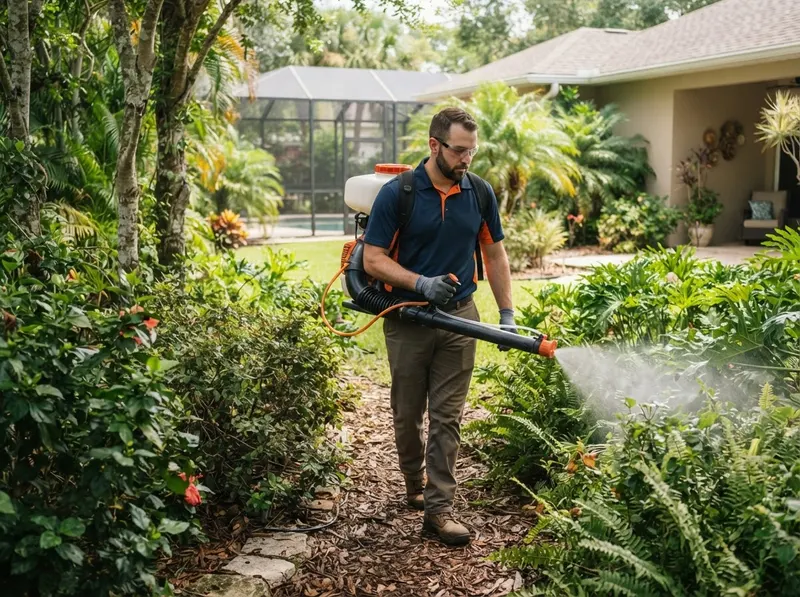
St. Petersburg properties face intense populations of Culicoides biting midges (commonly called no-see-ums) alongside daytime-biting Aedes mosquitoes. Coastal communities like Shore Acres, Coquina Key, and Snell Isle feature brackish soil, mangrove borders, and high water tables that serve as hyper-local nurseries for biting midges. Traditional store-bought foggers dissipate within hours in the Gulf breeze and fail to contact midges breeding in damp organic soils near tidal edges or around Crescent Lake and Sunken Gardens. Single-treatment barriers use micro-encapsulated active ingredients formulated to bond to the undersides of broadleaf plants, sea grapes, and palms, providing 21 to 30 days of insect knock-down even through standard afternoon rain showers.
Controlling biting midges requires a distinct chemical and physical strategy compared to mosquito extermination alone. While mosquitoes rest under the broad leaves of tropical landscaping in Historic Old Northeast and Kenwood, no-see-ums dwell in damp sandy detritus, lawn thatch, and shaded mulch beds. Application targets these ground-level emergence zones alongside dense perimeter shrubbery. For properties near Weedon Island Preserve or the Gulfport border along Boca Ciega Bay, treatments incorporate targeted juvenile hormone mimics and bacterial larvicides into catch basins, swales, and persistent low spots, arresting the insect development cycle before adults emerge to bite pets and residents.
A single barrier treatment suits planned outdoor events or acute summer flare-ups; recurring monthly maintenance is appropriate during the April-through-October rain cycle. The trade-off centers on residual longevity versus application frequency: continuous control in high-moisture neighborhoods like Euclid Heights and Disston Heights requires consistent disruption of the 14-day mosquito breeding cycle, whereas one-time sprays provide immediate relief for 3 to 4 weeks. Every formula applied dries completely within 60 minutes, remaining stable in high humidity while leaving no volatile airborne drift inside outdoor living spaces.
Every job gets a firm, written price after a free on-site visit.
Tell us about your mosquito and biting midge reduction job in St. Petersburg and we'll send a clear, written quote, usually the same day.
 Suncoast Sparrow Pest Control